When I was drafting my feedback framework I was thinking big -and I ran into some issues since then. So it’s time to rethink some choices and see if I can find a structure that ‘works for me’.
Designing the draft I had the goal to find a framework that works as a multitalent, that can be used in a broad variety of cases, ones that can fulfill every need ….silly me. Early on when we were engaging in our different proposals, trying out stuff I came to the conclusion that I don’t want to create one framework, but more think about different modules, building blocks that can be used to cater to the current needs/state/composition of the maker, the feedbacking group.
For me it’s very interesting to think about feedback also outside our MA-program, as this is something I am doing with my peers at home and now I’m even more motivated to engage with it in the Viennese scene. Nevertheless, for now, for this framework design I will focus on our little peer group and the circumstances we have here at HOME.
self-facilitating
Although I’m a big fan of the role of the facilitator (I like doing it, and as an artist, I like the relaxation that comes with not being responsible for the space and organization, leading me to be more open and receptive for the group’s comments ) I came to realize that during the creation periods at home there is never enough time to really get into explain what the artist wants in terms of feedback, it is very last minute, insecurities stay with the facilitator, which is shown during the sessions. The facilitator feels the need to check back a lot in with the artists, which makes their role kind of absurd. As an artist, I feel, having a facilitator needs giving up control on my side. In order to do so, I need to feel trust towards the person and have enough time to explain what I want (if it’s not something they know). Since this, I guess, won’t be the case in our future sessions, as everyone is busy with their own thing, I think I will stay with self-facilitating.
[As a sidenote: Facilitating is also a skill that needs to be trained. We never really talked about what it takes to make everyone feel safe. As I remember apart from time keeping, we didn’t really thematized the role on a deeper level. Dealing with that topic as a group could maybe lead to more engagement with that role]
less is more
During all the feedback sessions realized that proposed rounds need to be able to breath. We need to set aside time for explanation and answering questions for clarity. In my experience it was more enjoyable (as the maker and also as the feedbacker) if there were less rounds and therefore we could go deeper into it. Sometimes thoughts need more time to settle in, conversations evolving, so cutting everything to a minimum time frame can risk leaving the feedback on a surface level.
supporting the feedbackers
Thinking about how I can support the group, make them feel comfortable and not ask too much and overload them, I would like to refer to the two previous sections. When I am giving feedback I feel comfortable when there is a person in charge of the room (doesn’t matter if it’s the maker or a facilitator) It’s nice when someone takes responsibility for example after the showing’s applause and not leave the group hanging, not knowing what’s coming next.
Time pressure was a bit stressful and for me counterproductive in the sessions. Someone announcing: “2 minutes left for this round” felt a bit strange. I believe I’d like to play the timing issue more naturally, of course setting estimated time frames for myself, but when there is a lot to discuss, giving it the times that needs. Best letting things come to an end naturally. This needs a framework that is not fully packed with various different rounds. So maybe three max 4 rounds in 45 minutes seem ok. If it’s more it becomes again stressful for the group to jump from one mode to another, getting explanations quickly to save time and pressuring them to produce thoughts in a very limited time.
My Framework
- Mind Map (individual, ca 7 min, the paper stays with them throughout the session so they can scribble)
- Assigned roles (might include “What worked for me…”, Questions, Opinions, Open Discussion)
- Peer Wisdom (Tips/Tricks, The Field (References), Production Team, Open Discussion)
The underlying structure that follows this framework is:
1. Artistic, intuitive answering
For now I chose the Mind Map, but it can be replaced by other artistic, intuitive rounds such as
– story building
– artistic responses as performance
– a performative setting like the sun
– gossip round/bar talk
This round gives the feedbackers time to digest what they have just experienced, plays a bit more into the experience, rather than brainy, dramaturgical dissection. And at the same time prepares the group for the upcoming round, where we dive more into analyzing concepts.
2. Discussion about the work/ the topic
I find the assigned roles very informative, but it could be also be a round or a combination of:
– debate
– dramaturgical operations/concepts
– answering to conceptual keywords
– open discussion
– open questions
– open discussion with or without an artist’s question
– Affirmative round (What worked for me…)
This is the core of the framework. It gives the chance to dive into the concepts and dramaturgical issues
3. Peer Wisdom, depending on the state of the project.
– Tips/Tricks
– The Field (References)
– Production Team
– Open Discussion, with concrete questions
After a deep interaction with the work and concepts this last round should help me as an artist to find some help, maybe get some ideas on how to put the discussed things into practice, get references. It can be a lot more practical than the round before with a clear focus on the future development of the work.
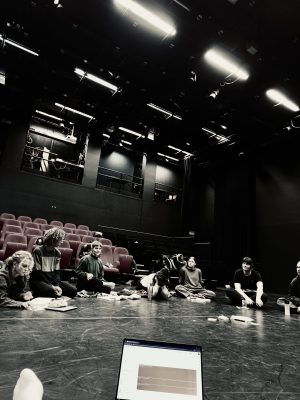 Through these modules I can stay flexible and adapt to my and my work’s current needs. Sometimes I might need more reference, sometimes I have some issues with sound design that need attention. Sometimes I need some affirmation, sometimes I might need to be reminded what my concept wants to tell. I believe these three parts can serve that and carry me and my work through different stages. The big structure is easy enough to follow and at the same time adaptable with it’s subcategories. Of course I didn’t have the chance to try it, but I’m excited to do so and if needed further develop it. I believe my framework, like my artistic work, must be in constant change and it can be fruitful to observe where the needs develop and stay open for adaptation.