As we were working in groups and deciding together how we want to get feedback and which methods we want to try, we decided to create a mixture of sections from our drafts. We deliberately chose rounds, that were not in the HOME framework to try out something new – for us and for the group. Moreover we picked rounds that could be hard/controversial to see what they are doing. I believe we need to acknowledge that this particular group is already used to a distinctive way of feedbacking. So it was interesting to see how a ‘new’ group, or a group who is used to be working with something else reacts and deals with the different suggestions and formats we were proposing. That gives me insight on to think about which methods I want to use for which group, how much time I need to set aside for explaining the specifities and how easy or difficult it is to pick up on a method, a certain wording that I am introducing and use it in the intended way.
While I’m writing this I realize that my mind is mostly occupied with thinking about and catering to the group and thinking about them, and less with what kind of feedback I want or need in a certain moment. I believe that can be partly because with these experiments we are in right now, we are creating and feedbacking in an artificial laboratory-like setting. There is very limited time to first create and then think about “What (kind of) feedback do I need/want right now?” and negotiating everything with a group, balancing individual wishes with group consensus.
Nevertheless, here’s my attempt of doing so:
Affirmative feedback is really important to me. Often I’m quite insecure about my work and I know I work better, get a motivation boost, when receiving some kind of approval. But apart from this personal condition, affirmations of specific moments, ideas, thoughts, concepts within the art work, let me know of what I can build on, what is working already. I perceive that as very helpful for future processes with that art work. Since this refers often to specific moments/dynamics of the given work I feel this is more beneficial when continuing the work with that proposal, and less as an overall feedback, for conceptual processes. At least this is how I experienced it within our session and in past experiences with it.
I often have a slight reluctance towards ‘tech stuff’, so the questionnaire was an interesting one for me. I think in setting up this round we were considered more with the frame than with the content. We could have paid more attention to the mode of questions we proposed in the online form, to work out more and be specific of WHAT kind of feedback we wanted to get out of this. Maybe balancing broader conceptual questions with more specific ones. As the questions sometimes were not clear or confusing for the feedbackers, I believe there should also be some effort put into guiding the individuals, maybe thinking of language accessibility etc. However, with all these issues, when I saw the answers, I was happily surprised. We got a multitude of interesting answers – oscillating between conceptual considerations, ideas connected to the piece, and specific actions and workings in the work. Although there might have been some individual unclarity towards the questions, in the end it doesn’t matter too much as we harvest from the whole group.
After the session I was reflecting as well on the position we gave this section in the framework. As we put it in the very begin of the session (we thought it’s nice to have the individual answers directly after the sharing – not affected by a conversation) I felt that the question very much framed our field of interest and concepts, which -of course- can be a good thing. At the same time I am always quite interested in how my work is perceived, or better said, what is understood from my work, without laying out the concept or ideas beforehand. Therefore next time, I think I want to try the questionnaire as the last part of the session, maybe even at home, and directing the questions a bit more towards an outcome I am (or my group is) determining.
Generally I would be very interested in looking into an overall dramaturgy of a feedback session, and although it is in the back of our heads when we talk about the sections, there was not really time and space to go deeper into that when preparing for our session this time.
Zooming In – Finding Out
Here are some topics that came up in our feedback session – throughout one or more round, trough one or more person(s)
audience’s consent
politics, media – hierarchies in distribution of information
audio description (and our – the maker’s – relation toward it)
audience spacing
objects on stage
reality of a performance context
At this moment it’s not clear if we will continue with this performance proposal concretely, with some of its ideas or if we start another process from the start. Some people in the group were changing and it has not been concluded on how to deal with the situation.
In the process of thinking about that I am observing that the more open a feedback is, the better it can be transferred to any other process, the more specific thew more likely it is more useful for this specific one. So this is a learning I want to keep with me on my journey of creating frameworks.
We had, for example, the topic of audience consent, about touching the ankles, being photographed. Funny enough that usually I am quite aware of this topic and in this process I just didn’t think of it, this is a consideration that I will bring into future processes, no matter what it is about. I also like the idea about playing with content notes in general and playing with expectation, eg writing something that is not gonna happen. So for the next creation round I will bring the awareness about the audience for sure, and if it’s fitting the work, we can have a look into the topic of content notes/warnings as well.
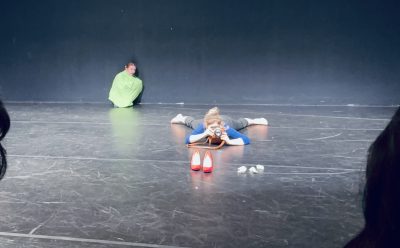
Because of the uncertainty on what my group will work in the next round it’s hard to tell what EXACTLY I will bring from this feedback to the upcoming. I like to perceive receiving feedback in line with Le Guin’s carrier bag, meaning that I have this smorgasbord of input, transferred knowledge, shifted perspectives that I can pull them out whenever it’s needed.