This week’s round of creation and feedback was somehow special, because we, as a group put the emphasize more on working together than towards the outcome. We developed this methodology of shifting roles and fields of responsibilities in the process hourly. Ruminating on our feedback session we had three aims:
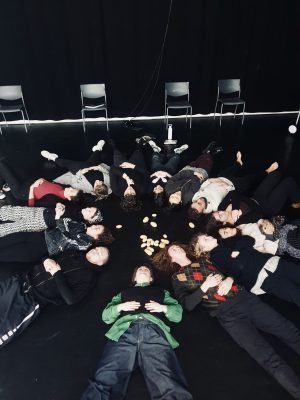
1. Similar to last week, take the opportunity to try out something new. Which I believe we did throughout the whole structure we set up. I would like to highlight our interest in performative spacing, which we took from last week’s ‘gossip round’ and wanted to take a step further. That’s why we came up with the sun, creating a spatial and a bodily condition, reminiscent of star gazing and cloud watching. I found this particularly interest as the group came out of discussing and sharing mode when we invited them to lay down together. It took a while to relax, people were active, maybe a bit nervous, but once settled in, the calmness was embodied and we could dream and phantasies a bit together about the piece. I found it super interesting to see what some moments of silence could to, shifting the body’s state, the tone of voice and thus influence how we think, how we reflect on things, what we share and how we communicate with each other. For me it felt a bit like a collective meditation about the piece/process.
2. As the process was that important to us, we wanted to share not only the outcome but also the mode of working together. Having in mind questions that came up during this module in conversation with my peers like: Who is the feedback for? What is the benefit, not only for the maker but also for the feedbackers in the process? As we thought of our process as very valuable for us, we wanted to share that with the class, that they could be part of this learning experience as well. Therefore we took some time to explain what we did and then reflect together about issues we had, how it affected the outcome etc. Although this round was as well a chance of reflection for ourselves, I believe it was more dedicated to transmit our experience to the group. A moment of giving back, not only taking from the feedbackers.
3. As we worked with assigned roles in our process, we wanted to have that mirrored as well in the feedback session. The feedback session in a way was still also a sharing of the working method, as we chose to assign different roles to small groups of the feedbackers. That way we wanted to give the group the chance to feel how it is to work with roles artificially assigned from the outside and at the same time get feedback from different perspectives we chose and felt fitting for the work. We chose two ‘professional’ roles from the field (choreographer and dramaturge) and two ‘private’ ones (for the lack of a better word I call them ‘private’) (Noemi’s mum – a stand in for a ‘normal’ person who might not watch performances a lot and activist. Each person was part of one of each category. This round was amazing for me. Especially the activist role was very valuable, as it puts on a political perspective, but doesn’t necessarily declare which one or what the starting point should be. I believe everything is politically all the time, so is my art and I want it to be read like that. Putting in that perspective, hearing different interpretations was very enriching and gave me food for thought. Probably I will keep this method and especially this perspective in my framework. The mum role was also very interesting. Given that I want to make art not only for a high art/academic audience it was good to hear more mundane comments, things that are easy to overlook when busy with our complex concepts and issues. It was also a lot of fun seeing my peers embodying this role (I think because it’s kinda of the opposite of what we are doing int his program) and I had the feeling it was also fun to do it for them.
Having said that the two ‘professional’ roles felt a little more ‘basic’ for our cohort, as these are the perspectives we often try to hold when we give feedback. Nevertheless I think it is nice to have a clear distinction (in our case choreographer and dramaturge) to refine our thinking and practice out of which perspective we say what – and subsequently leave this categorization again – but it’s good training!
In my opinion this week’s feedback session worked out very well, as we intended it to be. We got a lot of impressions, interpretations, ways of reading it. With the process as a center point we discussed about taking on roles, in an artistic process as well as in feedback giving. The week before we did also a round with perspectives, where the role could be feely chosen according to the comment that was made. That didn’t work as well as this week with the ‘fixed’ assigned roles. We didn’t get so much tips and tricks, references etc, but as we won’t continue this work, it was more useful to design a framework to concentrate on how things are perceived than thinking about how to continue this work.
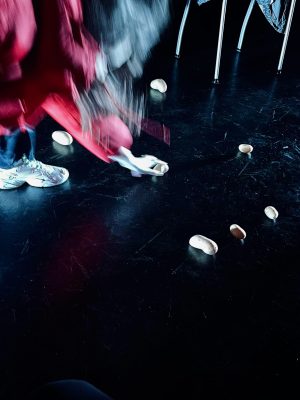
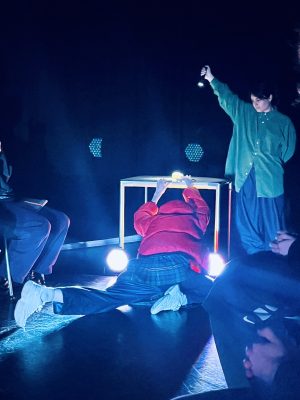
If I have to choose one thing that I will implement from the actual feedback (not speaking about the framework) I would choose the topic of ‘helpers’ on stage. There was a discussion about the people who were not the ‘solo’ performer but helped with lighting, music, throwing potatoes. we didn’t give these roles much thought, as some practical tasks had to be fulfilled. Reading us four as the group of creators created some curiosity in the feedbackers on how those practical roles could play a part in the meaning of the artwork (eg. the supplier of the potatoes = holder of power) Moving forward this can be an interesting notion, when working with stage hands, technicians, also musicians, riggers etc. if and how they can be part of the art work. How do I want to deal with practicalities artistically? Hide them, give them a stage, a purpose, emphasize them and their importance? -I know that is not exactly something concrete, but for sure a negotiation I want to engage in when thetime has come.