Feedback Frameworks
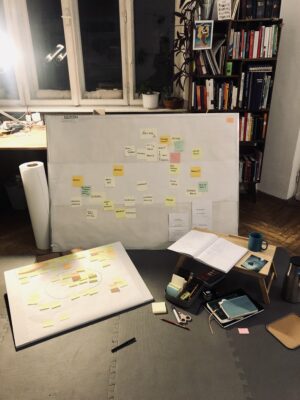
The module journey begins — yet I believe the feedback journey began with our births. Since then, we have constantly received feedback from our surroundings: how we behave, dress, speak… how we perform our roles as humans with certain identities.
Artistic feedback processes are a bit different from the everyday feedback we receive. They usually serve a specific purpose — often to (further) develop an artistic idea. That’s why I like to call this process “feedforward.” We engage in it to nourish the future development of the work, so it only seems right to emphasize the forward motion rather than the backward.
A few years ago, I discovered the DAS Arts Feedback Method and fell in love with it – with its thought-out structure that carries the session, its dramaturgy within the feedback process, and the variety of perspectives and positions it offers on an artistic proposal. It all makes sense to me. One very important notion I took from it: feedback is a present. And the important reverse of that you don’t have to take it, if you don’t want to, just like a gift.
With the help of this or also other method I realized that feedback can be more than “I like it” or “I don’t like it”. A certain structure prevents us to go into personal opinions and presumptions and keeps the focus on the art work.
The dark side
“You are not creative.”
(Feedback from my high school art teacher when I showed her my minimalistic/conceptual painting for a task she probably imagined differently)
“You will never become a dancer.”
(Feedback I received from an art institution when I auditioned for the BA program in Dance)
“It’s too messy, too much — I can’t even give feedback.”
(Feedback after a showing where I tried to do exactly this)
“You are too controlling.”
This one hurt me a lot. The person was supposed to give feedback on my art but ended up giving feedback on my personality.
I was part of a residency program where I had a studio for ten days. Each day, two or more people from a pool of “experts” came in the evening to see some draft/sketch/process and give feedback on it. It was quite an intense setup, and I was surprised that there was no consideration whatsoever about how feedback was given.
With the knowledge of the DAS Arts method I’m used to organizing my feedback sessions — so I did. I proposed different rounds and prepared questions. What I heard was the above. A comment on my agency in how I wanted to receive feedback. That hurt a lot. There was no mention of the artistic process I had just shared. Apparently, they had a different approach to feedback than I did — one that resembled more being a lamb on a chopping block.
Later, I reflected on that situation. The person was the leader of the program — a white, middle-aged, cis male — usually in a position of control. The topic of my performance proposal was about gendered power dynamics. So I guess, in his world, the feedback made sense: he was simply recreating what I was working on.
The bright side
My learnings
I will fight for my agency over my own feedback process.
I will look at the power structures within a feedback situation and how external factors (status, privilege, positions of power) influence them.
I will be aware of people’s general attitude toward feedback.
Is there a meta-feedback?
In my case, I didn’t receive direct feedback on my artistic draft, but the overall situation and reactions showed me that the topics I’m working with are essential. It made me think that I could pay more attention to how I shape my processes around these topics — and how I want the process itself to reflect/reproduce/deconstruct them.