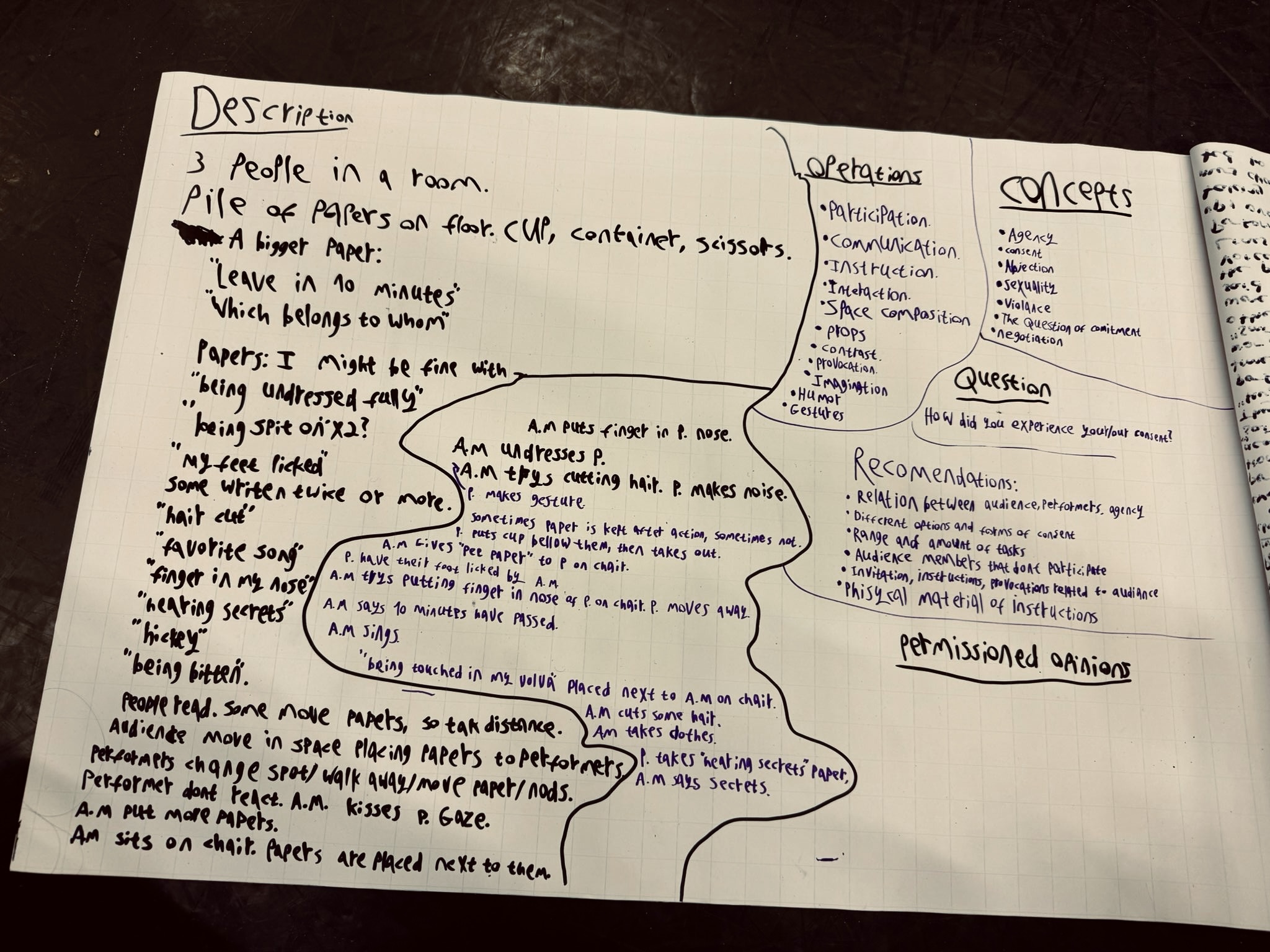
It was quite interesting to experience how the HOME feedback method was applied to this type of work. With so much simultaneity happening in the space, plus the multiplicity of focus that is shared by the performers as well as the participating audience could make it challenging to describe and feedback the work. The feedbackers agreed on mostly not describing the showing linearly but collected what was written on the given papers and their experience with the respective actions. So the organization of the performance wasn’t determined by time but by other topics, which I experienced as beneficial. The group identified various dramaturgical operations and concepts. Some of them were a big part of the creation process – or at least discussed or mentioned, some of them brought a fresh thought to the work and led to opening up new perspectives.
I would differentiate between two types of feedback in this session. There was conceptual feedback and feedback concerning the construction or crafting of the experiment. Although they have different approaches, I believe, they are inseparable, as the content is conveyed through the form and determined by it. For the sake of some structure I will organize it accordingly, but the boundaries will dissolve once we get deeper in medias res.
CONTENT
audience’s agency vs clarity
Obligation was mentioned as concept and noted as question of commitment (from the audience’s side). Moreover we were recommended to have an eye on audience members that don’t participate. I understand this as the topic of the audience’s agency. How can we propose a game that the participants want to be part of, so getting their consent, but at the same time opening the door for them to withdraw their consent and value their saying no? I believe that is a crucial question in this work, as it deals literally with this topic on a conceptual level. Negotiating consent, not only from the performer’s side but also from the audience’s is a big part of this work, therefore this we will revisit this point next time we are working on this draft.
involvement
We received a suggestion to look closer into the relation of
invitation – instruction – provocation
In my opinion this connects to the first topic, about how we want to approach the participants. How we want their agency to be encouraged or declined. I believe the focus on the mentioned distinctions can be a tool to clarify what the actual experiment is, which kind of game we want to play and what the thematical focus should be. Thus, if we would continue with this work, I would take this as a priority for the next research phase, where I would like to find some clarity in the experiment’s structure and therefore concept. In the course of this hypothetical exploration I would apply the proposed lens on invitation vs instruction vs provocation in order to clarify and differentiate the audience’s involvement.
forms of consent
Another recommendation was to consider different forms of consent. This was a big part of our discussion in the creation process, whether consent shouldn’t anyway always be verbal and how ethical it is the assume other ways of giving consent. The feedbacker’s comment makes me think that it could still be an interesting topic to examine, when is clarity needed and when ambiguity could be valuable. This question is in the core of this work, but also of my own artistic journey in general. At the same time the balance between concreteness and abstraction, clarity and opacity is a recurring topic in the process of my artistic work, thus, I will keep that in my pocket for any future processes.
FORM
tasks
We were recommended to consider the range/amount/spectrum of tasks we are offering the audience. I think this can be a crucial consideration, but first there needs to be a clearer shape of the actual game/interaction we are creating. Once this has gotten clearer, we could start thinking about the amount and range of thematic offerings we are suggesting in the work.
materiality
The invitation of reconsidering the material of the instructions, which was paper, is an interesting one for me. As I am working with this paper format throughout many of my research proposals, it was obvious using this for this experiment as well. In my bigger frame of research I am interested in the materiality of paper, but also focusing on it as a medium a holder of rules or information. As exactly that we were using it in this showing, so apart from being a handy prop, using this paper whenever it can be interesting in the frame of various experiments and projects, is building my research. So I am going to drop this proposition for now. However, I will keep it somewhere in the back of my head, as I feel, from time to time, it is good to revisit choices that are somewhat entrenched and question if they are still the right ones at the given moment.
The overall feeling I have after being part of the showing and the feedback session is that we would need to work on clarity. Through the feedback process I got some approaches and input on how to do deal with that task. Seeing other people engage with my artistic thoughts and processes in a non-judgmental way made me enthusiastic. I understand (my) art-making as a deeply relational process it gains its meaning through being witnessing and engaging.
Thank you!